Moving from a 2-cavity to a 9-cavity PET blow molding machine can raise output from around 2,500 bottles per hour to about 13,000 bottles per hour, but the decision affects much more than production speed. Equipment price, mold investment, electrical load, compressed-air demand, cooling requirements, maintenance access, and downstream line capacity all change as the machine becomes larger and faster.
For a factory owner or purchasing team, the real question is therefore not “How many cavities can we afford?” It is “Which cavity configuration can we keep productive at the lowest practical cost per saleable bottle?” A 2-cavity machine may fit moderate production and changing orders. A 6- or 9-cavity machine becomes more attractive when demand is stable enough to keep a higher-capacity line running. Between them, a 4-cavity configuration often provides a useful balance between output and investment.
Why Cavity Count Does Not Translate Directly Into Production Capacity
2- and 4-cavity machines suit flexible, small-to-medium production
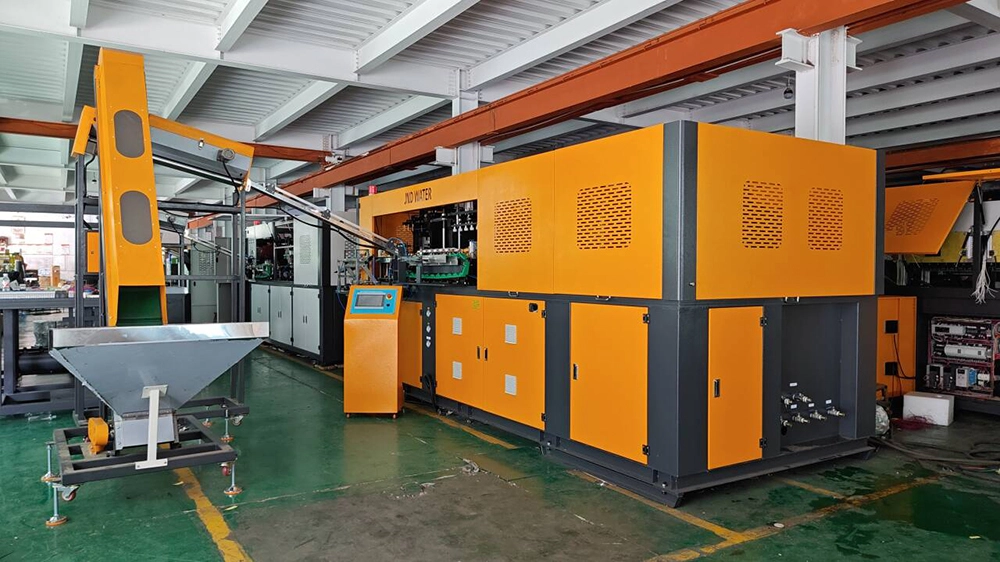
A cavity is one bottle-forming position inside the mold. A 2-cavity machine forms two bottles during each molding cycle, while a 4-cavity machine forms four. Yet the capacity increase is not simply a matter of multiplying cavity count by one universal cycle speed.
Bottle volume, preform weight, heating efficiency, stretching motion, blowing pressure, cooling time, servo response, and the overall machine design all affect actual throughput.
A representative 2-cavity automatic PET blow molding machine can reach about 2,500 BPH, while a 4-cavity configuration can reach approximately 6,000 BPH. Moving from two to four cavities therefore increases both the number of bottles formed per cycle and the potential hourly output, but the relationship is still influenced by the complete machine architecture.
For a factory producing several bottle sizes or working with fluctuating orders, a smaller machine can also provide operational flexibility. Less production capacity is tied to one machine and one bottle format, making it easier to schedule shorter production runs without leaving a large high-speed system underutilized.
6- and 9-cavity machines reward stable, high-volume demand
A 6-cavity configuration can raise theoretical production to around 9,000 BPH. A 9-cavity machine can move that figure to approximately 13,000 BPH. At these speeds, however, the blow molding machine can no longer be evaluated as an isolated piece of equipment.
Imagine installing a 13,000 BPH blower in front of a filling machine that can continuously handle only 8,000 bottles per hour. The extra blowing capacity does not create additional finished product. It simply moves the bottleneck downstream.
The same applies to bottle conveyors, labeling machines, shrink wrapping equipment, case packing, and palletizing. The production line should handle bottle flow as one connected system.
This is particularly important when considering a 9-cavity machine. Higher output also changes the load placed on preform feeding, heating, compressed air, cooling, and bottle transfer. Choosing the cavity count from the required finished-product output backward is usually more useful than selecting the fastest blower first.
Calculate real daily output with uptime and reject rate
Theoretical BPH is useful for machine comparison, but financial planning should focus on saleable production. A practical formula is:
Net daily output = Rated BPH × Scheduled operating hours × Availability × (1 − Reject rate)
For example, a 9-cavity machine rated at 13,000 BPH has a theoretical 24-hour capacity of 312,000 bottles before downtime and rejects are considered. If an internal production model assumes a 0.1% reject rate, that figure falls to 311,688 bottles before availability is applied.
Real availability must then account for mold changes, maintenance, preform interruptions, quality inspections, utility interruptions, and downstream stops.
The right cavity count is the one that keeps the complete production line productive at your real order volume, not simply the machine with the highest BPH.
CAPEX Versus OPEX as Cavity Count Increases
Mold material, cavity count, and tooling investment
Higher cavity counts normally require a greater tooling investment for each bottle design. This matters less when a factory produces one standard water bottle in long campaigns. The same mold investment can be spread across millions of bottles.
The calculation changes when a producer handles many SKUs. If the factory repeatedly switches between several bottle shapes and volumes, each additional mold represents more capital tied to tooling.
Mold material is another consideration. Aluminum alloys provide strong heat-transfer characteristics and lower weight, while steel offers different advantages in wear resistance, rigidity, and durability. Bottle geometry, cooling-channel design, expected mold life, production speed, maintenance requirements, and changeover handling should all influence the final tooling choice.
Higher output lowers unit cost only when the capacity is used
A 6- or 9-cavity machine can spread fixed costs across more bottles than a 2-cavity system, but that advantage exists only when sufficient orders keep the machine productive.
A useful cost-per-bottle calculation should include annualized equipment and mold investment, labor, electricity, compressed air, cooling, maintenance, floor space, spare parts, scrap, and production lost during changeovers.
For example, a factory producing one 500 ml water bottle throughout most of the year may benefit from the output of a 9-cavity machine. Another factory with similar annual demand but frequent bottle changes may find that a smaller configuration spends less time waiting for production schedules to catch up with its capacity.
This is why purchasing teams should compare utilization as carefully as BPH.
Automation, labor, and three-year TCO
Automation becomes more valuable when a factory runs multiple shifts or operates continuously. Fully automatic PET blow molding systems reduce repetitive handling by automating preform feeding, heating, stretching, blowing, and bottle discharge.
To compare 2-, 4-, 6-, and 9-cavity machines fairly, build a three-year total cost of ownership model. Include machine cost, molds, installation, operators, electricity, compressed air, cooling, preventive maintenance, spare parts, expected scrap, and planned downtime.
Then divide the three-year cost by the expected number of saleable bottles.
This method can reveal situations where a higher-priced machine produces a lower cost per bottle—or where a lower-priced machine delivers better economics because its capacity matches the actual order volume more closely.
How Much Does an Automatic Blow Molding Machine for PET Water Bottles Cost?
How prices change from 2 to 4, 6, and 9 cavities
There is no reliable fixed price for an automatic PET water bottle blow molding machine based on cavity count alone. In general, a 2-cavity machine requires a lower initial investment than a 4-cavity machine, while 6- and 9-cavity configurations move into progressively higher investment levels as production speed, drive systems, heating capacity, controls, and auxiliary requirements increase.
The price increase is not linear. A 9-cavity machine does not necessarily cost three times as much as a 3-cavity machine or twice as much as a smaller configuration. Higher-speed machines can use different servo systems, preform handling systems, heating layouts, air circuits, control components, and cooling arrangements.
The bottle itself also changes the quotation. A standard small PET water bottle creates different requirements from a larger bottle, an unusual shape, or a container using a heavier preform.
For budgeting, cavity count is therefore better viewed as one price driver rather than a complete price formula.
Why machines with the same cavity count can have very different prices
Production speed is one of the main reasons. Two 4-cavity machines may both use four molds, yet one can target moderate output while another uses a higher-speed servo architecture to produce significantly more bottles per hour.
Other factors include PLC and servo configuration, preform feeding, infrared heating, air recovery, mold-change design, electrical components, safety systems, remote diagnostics, bottle-neck compatibility, and spare-parts scope.
Molds may also be quoted separately. If your project requires three bottle designs, comparing machine prices without including the required mold sets understates the real capital requirement.
The same principle becomes increasingly important with a 9-cavity machine because the quotation needs to reflect both higher production output and the supporting systems required to sustain it.
Machine price is not the same as total installed project cost
A machine quotation and an operational bottle-production system are not the same thing. Depending on the project scope, a complete installation may also require bottle molds, high- and low-pressure compressors, air receivers, filtration, dryers, chillers, preform feeding equipment, conveyors, piping, electrical work, spare parts, freight, installation, commissioning, and operator training.
Shipping destination and local factory conditions can also affect the final project cost. A lower machine-only quotation may no longer be the lowest-cost option after all required auxiliary systems and installation work are included.
When comparing proposals, ask each supplier to quote the same production target and the same scope of supply. This makes it much easier to distinguish a genuinely lower-cost solution from a quotation that simply excludes more equipment.
Specific prices depend on the actual machine configuration and project requirements. Please contact us promptly with your bottle specification, target BPH, required cavity configuration, molds, utilities, and production-line scope to obtain an accurate quotation.
Factory Space Is More Than the Blow Molding Machine Dimensions
Main machine dimensions and maintenance clearance
Machine dimensions are important during factory planning, but they do not represent the total space required for production. Operators and maintenance teams also need access around the machine, while molds require sufficient clearance for removal and installation.
| Cavity Configuration | Representative Theoretical Output | Representative Full-Load Power | Approx. Machine Dimensions | Planning Focus |
|---|---|---|---|---|
| 2 cavity | 2,500 BPH | 55 kW | 4.3 m × 3.2 m | Lower production volume and easier integration into smaller production areas |
| 4 cavity | 6,000 BPH | 65 kW | 5.0 m × 4.2 m | Balances higher output with moderate factory-space and utility requirements |
| 6 cavity | 9,000 BPH | 72 kW | 6.5 m × 4.5 m | Requires downstream filling and packaging equipment that can sustain higher bottle flow |
| 9 cavity | 13,000 BPH | 115 kW | 6.5 m × 4.5 m | Designed around high-volume production with greater attention to utilities and complete line balance |
The dimensions above describe the main machine envelope. They do not include compressor rooms, chillers, air receivers, dryers, electrical cabinets, mold storage, conveyors, maintenance access, or downstream equipment.
This distinction matters during layout planning. A 6.5 m × 4.5 m machine may physically fit inside an available space, but that does not mean the space is sufficient if technicians cannot access service points or remove molds safely and efficiently.
Compressed air, cooling, drying, and utility space
Electrical demand also changes as output rises. The representative configurations above move from 55 kW for a 2-cavity machine to 65 kW for 4 cavities, 72 kW for 6 cavities, and 115 kW for 9 cavities.
However, full-load power is only one part of the utility calculation. PET stretch blow molding depends heavily on compressed air. The air system must provide sufficient pressure and flow throughout the blowing cycle, which means compressor capacity, air receivers, filtration, dryers, piping diameter, and pressure drop all matter.
Cooling requires similar planning. Chiller capacity, cooling-water flow, inlet temperature, ambient conditions, and water quality can influence stable production. A high-speed machine cannot maintain its intended output if the supporting utilities are undersized.
This is why a 9-cavity project should be evaluated from the machine and auxiliary equipment together rather than from the main-machine dimensions alone.
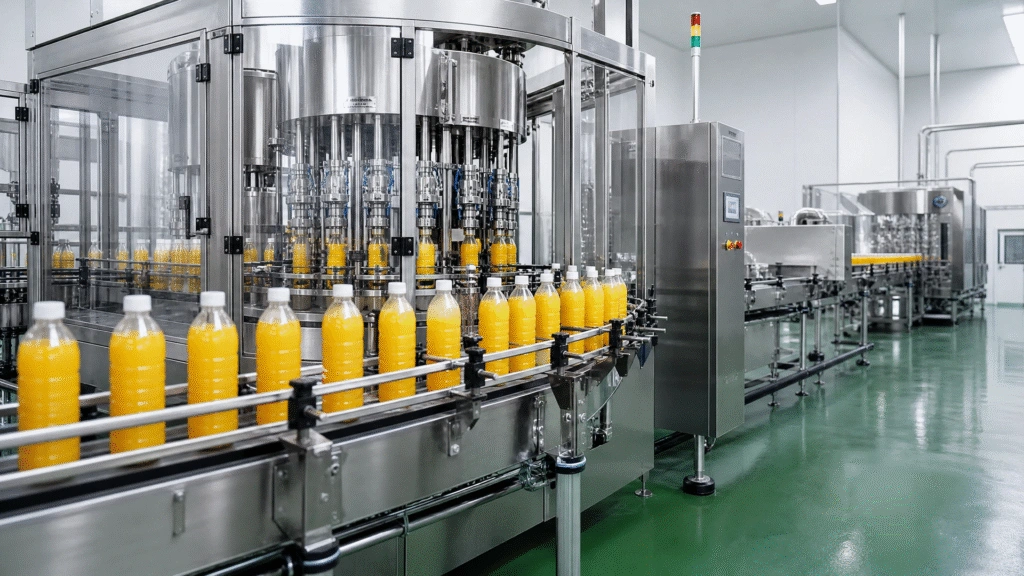
Production flow from preform heating to filling
Factory layout should follow the production sequence. Preforms move from storage and feeding through heating and stretch blow molding. Finished bottles then move toward rinsing, filling, capping, labeling, packing, and palletizing.
Every unnecessary transfer adds another point where bottles can accumulate or production can stop. Yet simply pushing every machine close together does not solve the problem either.
Good layouts leave practical space for maintenance, buffer conveyors, utility routing, operators, mold handling, and future expansion. Matching the blower with the filling and packaging line during layout design also makes it easier to prevent one section from limiting the output of another.
The Flexibility Trade-Off Behind Quick Mold Changes
Quick-change tooling reduces downtime but cannot eliminate its cost
Quick-change mold systems can reduce the time required to switch between bottle formats, but every stopped minute still represents lost production. That cost becomes larger as machine output increases.
For example, an hour of downtime on a 2,500 BPH machine represents far less potential production than the same hour on a 13,000 BPH machine. High-speed production therefore makes changeover planning increasingly important.
Multi-cavity tooling also commits more capital to each bottle design. If a factory frequently alternates between several bottle formats, buyers should compare the value of additional peak output with mold investment and lost production during format changes.
One 9-cavity machine or multiple smaller machines?
A single 9-cavity machine concentrates production into one high-output platform. This approach can work well when one or two bottle formats dominate the schedule and order volume remains consistently high.
Multiple smaller machines offer another type of flexibility. Two machines can potentially run different bottle formats at the same time, one machine can continue producing while another undergoes a mold change or maintenance, and additional capacity can be introduced in stages.
The trade-off is duplicated equipment, additional maintenance points, and greater overall installation complexity. The better configuration depends on whether your factory values maximum concentrated output or greater production flexibility.
Choose Cavity Count From the Bottle and the Business Case
Start with your annual sales forecast and convert it into realistic daily and hourly bottle demand. Add peak-season requirements, operating shifts, bottle sizes, preform weights, SKU count, changeover frequency, and inventory policy.
For a 2-cavity machine, determine whether 2,500 BPH is sufficient for current demand and near-term growth. For 4 cavities, assess whether approximately 6,000 BPH provides the right balance between output and investment. For 6 cavities, make sure filling and downstream packaging can continuously handle around 9,000 BPH. For 9 cavities, verify that the complete line and utility infrastructure can support approximately 13,000 BPH without simply moving the bottleneck to another process.
Then compare price together with output, power demand, compressed-air requirements, mold investment, labor, changeover frequency, factory dimensions, maintenance access, and total cost of ownership.
Before requesting a final quotation, prepare the bottle volume and drawing, neck finish, preform weight, target BPH, number of bottle formats, expected operating hours, available factory dimensions, electrical supply, compressed-air conditions, cooling-water conditions, and downstream production speed.
Those details make it possible to compare 2-, 4-, 6-, and 9-cavity configurations on the same engineering basis rather than judging equipment by cavity count alone. Specific prices are subject to quotation. Please contact us with your production requirements to obtain an accurate price for the configuration that fits your project.