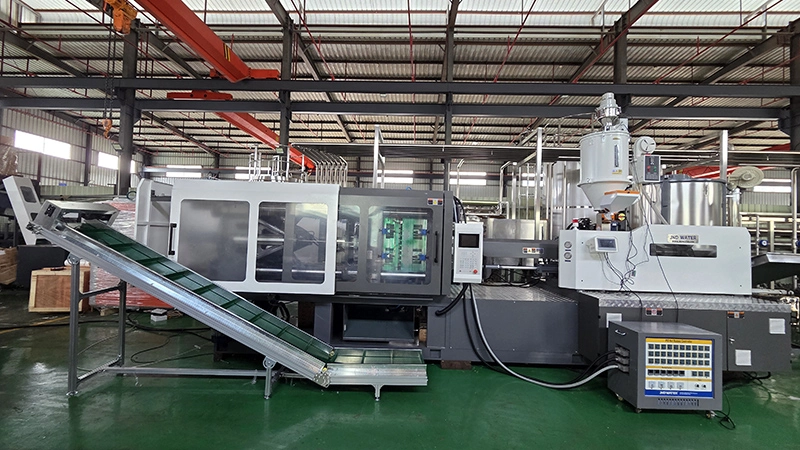
A filling machine spare parts list for a 24-head monoblock comes down to four groups: product-contact seals, capping machine grippers, water treatment cartridges and the sensors that track a bottle. The quantities below are worked from the water filling machine model JND24-24-8, which carries 24 filling valves, 24 capping heads and 8 rinsing heads across 6,000 to 8,000 bottles per hour.
Which Parts Belong on the Filling Machine Spare Parts List?
Four groups cover nearly every stop a storeroom can prevent: seals and gaskets in the product path, grippers and guide rails that touch the bottle, filter cartridges and lamps in the water treatment unit, and the proximity sensors that report position.
One full change of a JND24-24-8 takes 24 valve seal sets and 24 gripper inserts, because the machine carries 24 of each. Half a set of either leaves a partial rebuild waiting on the next shipment.
| Filling machine spare parts list, JND24-24-8 at 8,000 bottles per hour | |||
| Part | Fitted on | Quantity for one full change | Change interval |
|---|---|---|---|
| Filling valve seal set | Water filling machine, 24 valves | 24 sets | Twice a year |
| Capping machine gripper insert | Capping machine, 24 heads | 24 inserts | Quarterly |
| Rinsing nozzle | Rinsing section, 8 heads | 8 nozzles | Once a year |
| 5-micron pre-filter cartridge | Water treatment unit, 3-cartridge housing | 3 cartridges | Every two weeks |
| UV lamp | Water treatment unit | 1 lamp | 9,000 running hours |
The rinsing section is the cheapest group to hold: eight nozzles on a 24-valve machine. A blocked rinsing nozzle shows as foam in the bottle rather than as a stopped machine.
How Many Filling Valve Seals Does a Year Take?
Two changes a year across 24 valves is 48 seal sets, or four sets a month. Two shifts at 416 running hours a month put 3,328,000 bottles past the machine at 8,000 bottles per hour.
One seal set therefore covers 832,000 bottles, which is 34,667 bottles per valve. A set fitted late shows up first as fill level drifting on a single head, the same symptom that opens the fault list for water filling lines.
Seals bought one at a time get fitted one at a time. New and old seals on adjacent valves show up as two fill levels inside the same crate, and both pass a casual glance at the filling machine outlet.
| Units a year on a two-shift plant, 416 running hours a month | |||
| Part | Units per full change | Changes a year | Units a year |
|---|---|---|---|
| Filling valve seal set | 24 | 2 | 48 |
| Capping machine gripper insert | 24 | 4 | 96 |
| Rinsing nozzle | 8 | 1 | 8 |
| 5-micron pre-filter cartridge | 3 | 26 | 78 |
| UV lamp | 1 | 1 every 21.6 months | 21.6 months per lamp |
How Many Gripper Inserts Does the Capping Machine Need?
A quarterly change on 24 heads comes to 96 inserts a year, eight a month. At 8,000 bottles per hour each head closes 333 caps an hour, or 416,000 caps between changes on a 1,248-hour quarter.
Inserts wear on the cap skirt rather than on the bottle. A skirt that tears and leaks air during the capping machine torque check appears on the head with the most running hours, not on the head nearest the operator.
The cap chute and the cap knife belong to the same weekly round as the inserts. Both are low-cost items, and either one stops the capping machine outright rather than slowing it.
Which Consumables Come From the Water Treatment Unit?
A three-cartridge pre-filter housing changed every two weeks takes 78 cartridges a year, from 26 changes at three cartridges each.
Differential pressure across the housing confirms the two-week interval. A gauge reading that climbs before the calendar date means the cartridges are finished early, and the reverse osmosis stage behind them is taking the load.
The UV lamp is rated at 9,000 running hours, which is 21.6 months at 416 hours a month. One spare lamp on the shelf covers two years on two shifts.
Which Spare Parts Should Stay Out of the Storeroom?
The main motor, the gearbox and the touch screen fail rarely and cost enough to distort a stores budget. They sit with the manufacturer and get ordered against a machine that has already stopped.
One spare filling valve is the exception. With a valve blanked, 23 of 24 heads run and output falls to 7,667 bottles per hour; over a 16-hour day that is 122,672 bottles against 128,000.
A stores budget spread over rarely failing parts leaves nothing for the seals that stop the line four times a year.
Where Does the Reorder Point Sit?
Monthly draw times resupply time, plus one full change set, holds a line through a late shipment. Valve seals draw 4 sets a month, six weeks of sea freight takes 6 sets, and the full change set is 24, so 30 sets sit on the shelf.
Pre-filter cartridges draw 6.5 a month, which is 10 cartridges over six weeks, and one change of the housing adds 3. The reorder point is 13 cartridges.
The same arithmetic runs off the maintenance schedule intervals, so the two sheets carry the same numbers and one of them can be checked against the other.
Two shipments a year, one ahead of the high season and one behind it, keeps the shelf inside that holding without a second reorder during peak weeks.
FAQ
How many filling valve seals should be kept in stock?
One set per valve, so 24 sets on a 24-valve machine, plus the sets already in the next shipment. Anything below a full set turns a seal change into a partial rebuild.
Does a standalone capping machine need different gripper stock?
The count follows the heads, not the frame, so a 24-head capping machine takes 24 inserts either way. A monoblock and a separate machine at the same head count hold the same stock.
How long does a UV lamp last before replacement?
9,000 running hours, which is 21.6 months at 416 hours a month. The lamp hour counter on the water treatment unit gives the remaining figure without a separate test.
Can JNDWATER issue a spare parts list for a machine already running?
The model code carries the head count and the serial number ties it to the delivered configuration. JNDWATER issues the list with annual quantities against both.
Send the model code, head count and shift pattern to receive a filling machine spare parts list with annual quantities and a quotation. The sales team replies against the delivered configuration, and the factory keeps the part numbers on file.