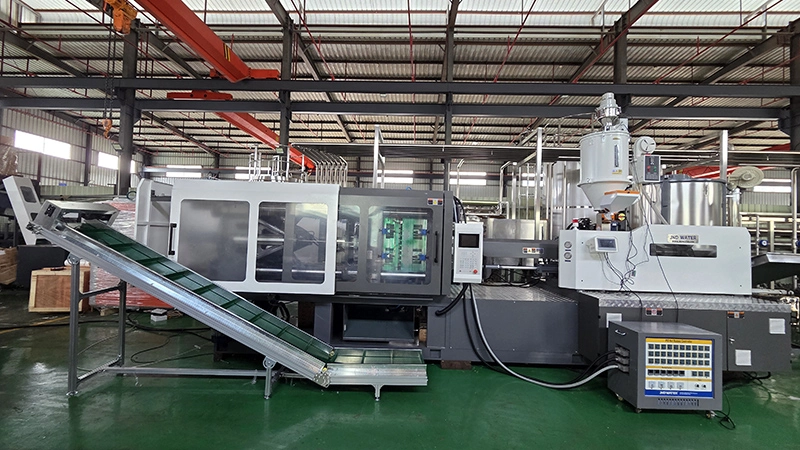
Six alarms account for most stops on a PET blow molding machine, and each one costs output that can be counted in bottles. JNDWATER builds five models from the 2,500 BPH JND-SS2500 to the 9,000 BPH JND-H6, and blow molding machine troubleshooting on all five runs through the same order: preform feed, heating, blow pressure, clamp, ejection, rated output.
Which Alarm Comes First in Blow Molding Machine Troubleshooting?
A preform that arrives out of round, or a rail opened a millimeter too wide, stops the feed wheel before the oven.
The JND-H6 at 9,000 BPH takes 150 preforms a minute, so a ten-minute feed stop costs 1,500 bottles. The 2,500 BPH JND-SS2500 loses 417 in the same stop.
Neck ovality, rail gap and static from over-dry preforms cover most feed stops. A neck gauge at the infeed and a fixed rail setting remove the first two.
Feed rails are the first weekly item on the bottled water line maintenance schedule.
What Does One Heating Zone Fault Cost in Wall Thickness?
A lamp gone dark in one heating zone leaves the preforms on that side short of temperature, and the bottle comes out with a thin panel.
On the six-cavity JND-H6, 9,000 BPH divides into 1,500 bottles an hour per cavity. One cavity scrapping its output costs 1,500 BPH, which is 16.7% of the rated figure.
An ammeter on each zone shows the failed lamp before the bottles do, and a pyrometer at the oven exit confirms it.
Cavity count sets that per-cavity figure, and the 2, 4, 6 and 9 cavity comparison carries the output side of it.
| Blow molding machine troubleshooting: alarm, usual cause, first check and what it costs on a 9,000 BPH six-cavity machine | |||
| Alarm | Usual cause | First check | What it costs |
|---|---|---|---|
| Preform feed stop | neck ovality, rail gap | neck gauge at the infeed | 1,500 bottles per 10 minutes |
| Heating zone fault | failed quartz lamp | ammeter on each zone | 1,500 BPH per cavity |
| Blow pressure low | leak, saturated filter, undersized supply | gauge at the blow valve | 7,200 BPH at a 3 s recovery |
| Clamp or gate alarm | fragment on the parting line | parting line and gate switch | 12,000 clamp cycles a shift |
| Bottle sticking | water temperature and flow | setpoint at the base insert | 6,750 BPH with 20 s a minute |
| Output below rated | preform moisture, cycle setting | preform storage and cycle time | 8,100 BPH at 90% of rated |
Why Does the Machine Stop When Blow Pressure Drops?
High-pressure air forms the bottle, and a supply that cannot recover between cycles trips the pressure switch before the bottle is fully formed.
9,000 BPH across six cavities is 25 cycles a minute, a 2.4-second cycle. A supply needing 3 seconds to recover caps the machine at 20 cycles a minute, which is 7,200 BPH.
A leak at the blow valve, a saturated filter and an undersized compressor read the same on the gauge. The gauge is read at the valve, not at the compressor outlet.
The air compressor and its dryer are sized on that recovery time as much as on average consumption.
What Wears Out Behind a Clamp Alarm?
A clamp alarm is usually a gap rather than a pressure fault: a preform fragment on the parting line holds the halves apart and the switch reads it.
At 25 cycles a minute the JND-H6 closes its mold 12,000 times in an eight-hour shift, and 7.2 million times across 600 shifts.
Toggle bushings, the gate switch and the ejector return spring carry that count. One spare gate switch belongs in the first spares order for that reason.
Mold changes disturb the same alignment, and the reset sequence sits in the mold change guide.
Why Do Bottles Stick in the Mold or Come Out With a Deformed Base?
A bottle that stays in the cavity is a cooling problem at the base, where the wall is thickest and the water is furthest away.
Freeing stuck bottles by hand for 20 seconds in every minute drops the six-cavity machine from 150 bottles a minute to 112, which is 6,750 BPH against 9,000 rated.
Water temperature at the base insert and flow through the mold decide the release. The water chiller range covers +3 to +45 °C, and the setpoint is read at the mold rather than at the chiller panel.
A worn ejector pin leaves the bottle on the core even when the water is right. Ejector pins go in sets, and the spare parts list covers the wear items around them.
Why Does a New Machine Run Below Its Rated Output?
The output column on the spec sheet is theoretical, and a machine running at 90% of it is running normally.
90% of 9,000 BPH is 8,100, so the gap is 900 BPH. That gap is 7,200 bottles in an eight-hour shift and 4.32 million over 600 shifts.
Preform moisture, air recovery, conveyor back-pressure and a cycle set longer than the bottle needs all sit in it. Moisture shows as pearly streaks above the base.
The high speed PET bottle blow molding machine page lists theoretical output against cavity count for each model, with total power beside it.
| Cycle time and clamp cycles computed from the theoretical output of the five PET blow molding machine models | |||||
| Model | Cavities | Theoretical output | Bottles per cavity per hour | Cycle time | Clamp cycles per 8-hour shift |
|---|---|---|---|---|---|
| JND-SS2500 | 2 | 2,500 BPH | 1,250 | 2.9 s | 10,000 |
| JND-SS4000 | 4 | 4,000 BPH | 1,000 | 3.6 s | 8,000 |
| JND-E4000 | 4 | 3,500 BPH | 875 | 4.1 s | 7,000 |
| JND-H4 | 4 | 7,200 BPH | 1,800 | 2.0 s | 14,400 |
| JND-H6 | 6 | 9,000 BPH | 1,500 | 2.4 s | 12,000 |
Two four-cavity models sit at opposite ends: the JND-E4000 at 3,500 BPH runs a 4.1-second cycle, and the JND-H4 at 7,200 BPH runs 2.0 seconds. The cavity count is identical, so the difference is cycle time and the heating and air behind it.
Frequently Asked Questions
What is the most common blow molding machine troubleshooting call?
Preform feed jams at the unscrambler, usually from neck ovality or a rail set too wide. On a 9,000 BPH machine a ten-minute stop costs 1,500 bottles.
How much output is lost when one heating lamp fails?
On a six-cavity machine one cavity is worth 1,500 bottles an hour, which is 16.7% of the rated 9,000 BPH. The zone ammeter shows the lamp before the bottles do.
Does low blow pressure reduce output or stop the machine?
Both, depending on where the pressure switch is set. A supply that recovers in 3 seconds holds a six-cavity machine at 7,200 BPH instead of 9,000.
Why does a new blow molding machine not reach its rated output?
The rated figure is theoretical, and normal running sits near 90% of it. Preform moisture, air recovery and conveyor back-pressure account for most of the difference.
Bottle volume, preform weight and target bottles per hour are enough to start a model selection with JNDWATER.