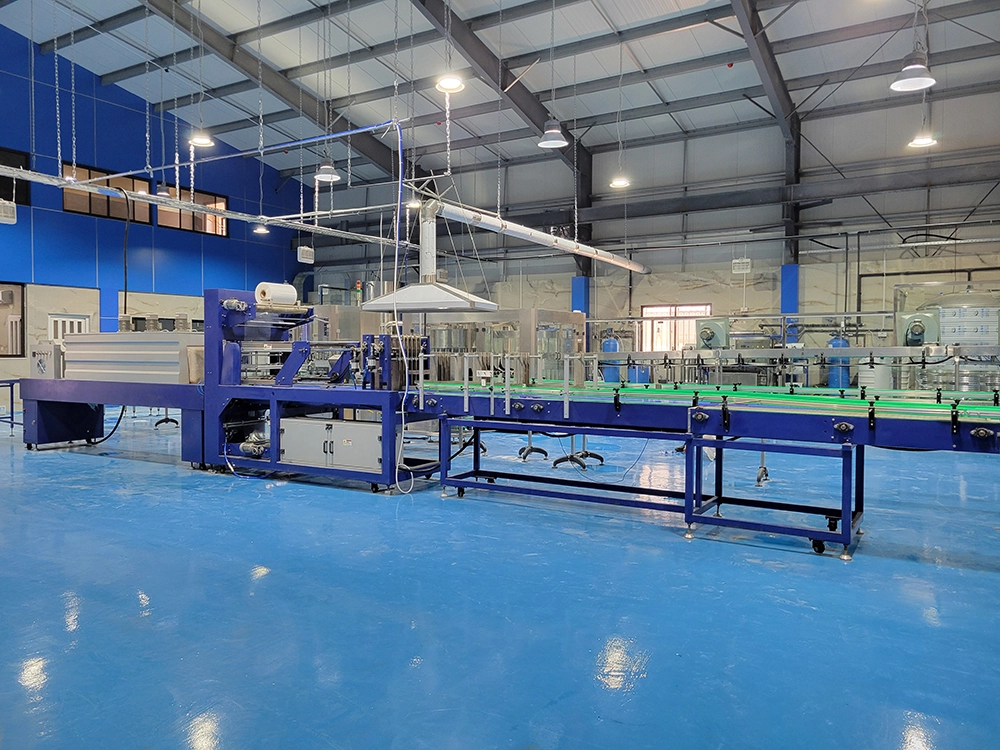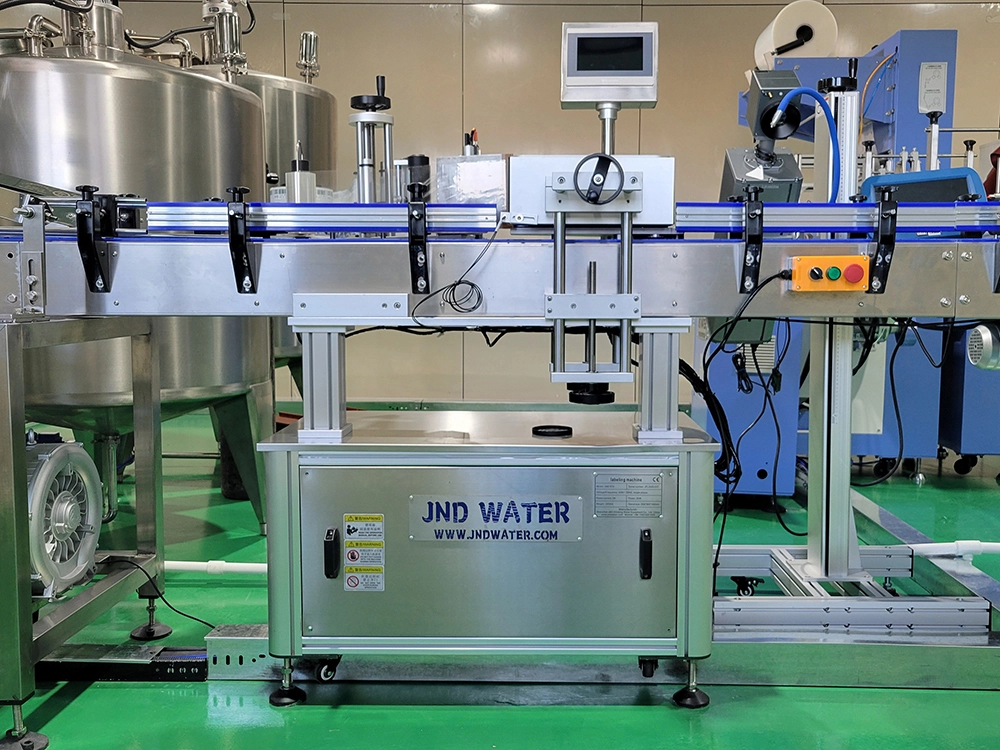
Packing machines are critical equipment at the end of a beverage production line. When a packing machine malfunctions, the entire production line may be forced to shut down. Bottle misalignment, broken film cutting, and uneven shrinkage are the three most common problems.
Jndwater has over 20 years of experience manufacturing complete beverage production line equipment and has served more than 125 countries worldwide. Our shrink wrap machines, shrink wrappers, automatic shrink wrap machines, and sleeve wrapping machines are widely used in the food and beverage industry.
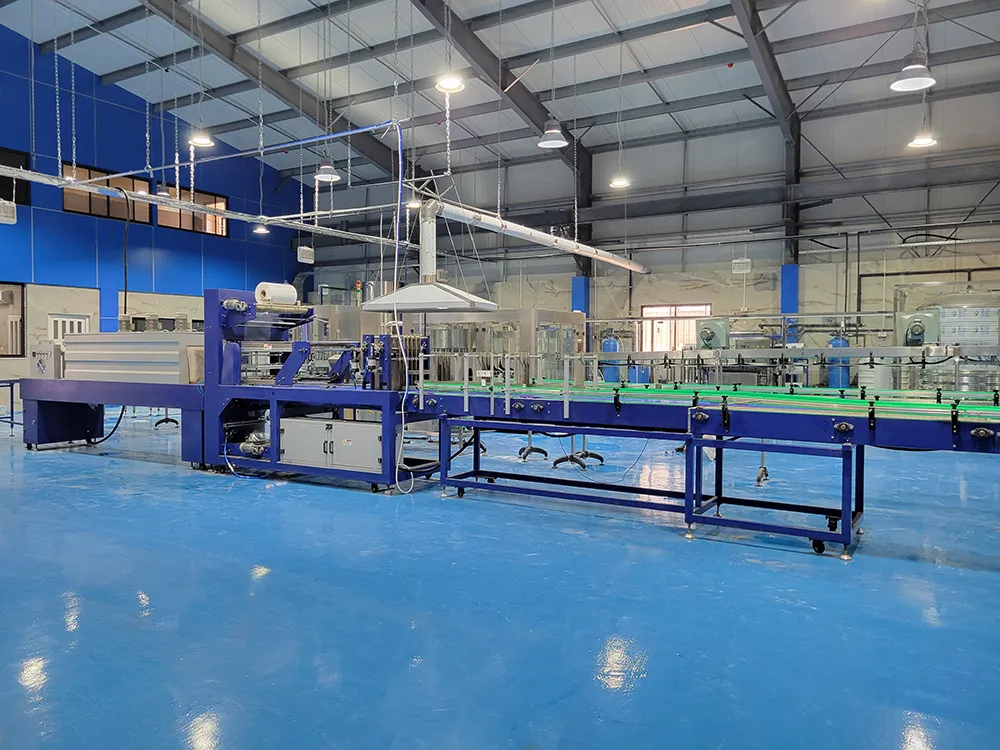
Bottle Sorting Disorder: Troubleshooting Packing Machine Feeding Process
Bottle sorting disorder refers to the inability of products to form a neat arrangement before entering the shrink wrap machine, leading to bottle blockage, machine jamming, or packaging misalignment.
Main Causes (Shrink Wrapper Feeding System)
- Mismatch between feed conveyor belt speed and shrink wrap machine: Too high a speed causes product compression, too low a speed results in excessive gaps.
- Worn or misaligned bottle-soring screw: Inability to evenly separate products.
- Dirty or malfunctioning photoelectric sensor: Inability to accurately detect product position.
- Inappropriate guide rail width: Too wide causes product swaying, too narrow causes bottle jamming.
Automatic Shrink Wrap Machine Bottle Sorting Troubleshooting
Step 1: Adjust Conveyor Belt Speed Matching
The feed conveyor belt speed should be synchronized with the main conveyor belt speed of the shrink wrap machine. Typically, the feed end should be slightly faster to create slight accumulation pressure, but the pressure should not be too high.
Step 2: Check the Bottle-Sorting Screw
Confirm that the screw surface is free of wear, and the gap between the screw and the guide plate is 1.2-1.5 times the bottle diameter. If the gap is too small, it will scratch the bottle; if it’s too large, it will cause inaccurate bottle separation.
Step 3: Clean and calibrate the photoelectric sensor. Clean the sensor lens with a lint-free cloth. Check that the sensor’s installation position is aligned with the product’s detection point. For transparent bottles, an ultrasonic sensor or a reflective photoelectric sensor may be needed.
Step 4: Adjust the bottle guide rails. The rail width should be slightly larger than the bottle diameter (usually 2-5mm larger). For irregularly shaped bottles, adjust according to the widest part of the bottle.
Bottle Sorting Disorder: Troubleshooting Packing Machine Feeding Process
Uncut Film: Troubleshooting the Shrink Wrap Machine Sealing and Cutting System
Cause Analysis: Shrink Wrapper Sealing and Cutting Unit
- Dull Cutter: Blade wear after prolonged use
- Insufficient Sealing and Cutting Temperature: Film not completely melted
- Insufficient Cutter Pressure: Cylinder pressure too low or mechanism jammed
- Cutter Surface Adhesion: Molten film residue remains on the blade surface
- Damaged Heating Element: Uneven heating or localized lack of heating
Automatic Shrink Wrap Machine Film Cutting Problem Solutions
Step 1: Inspect and Replace the Cutter
The normal service life of the cutter is approximately 3-6 months (depending on production volume). Use blade edge test paper to check the uniformity of the blade. Replace it immediately if dulling is found.
Step 2: Adjust the Sealing and Cutting Temperature
The standard PE film sealing and cutting temperature is 120-160℃. Gradually increase the temperature in 5℃ increments until the film is completely cut. Excessive temperature will cause the film to melt and stick to the cutter.
Step 3: Check the Cutter Pressure
Check if the cylinder air supply pressure is within the range of 0.4-0.6MPa. Step 4: Clean the cutter surface. After stopping the machine, use a copper brush or high-temperature anti-stick agent to clean any residue from the cutter surface. Check if the Teflon coating on the cutter surface is peeling off; if so, repaint or replace the part.
Step 5: Test the heating element. Use a multimeter to measure the resistance of the heating element to determine if there is an open circuit. Also check if the thermocouple is making good contact and if the temperature control display is accurate.
Uneven Shrinkage: Troubleshooting Heat Shrink Wrapping Machine Channel Problems
Uneven shrinkage manifests as inconsistent film tightness, wrinkled edges, and localized melt-through.
Causes of Uneven Shrinkage (Heat Shrink Wrapping Machine Channel)
- Uneven temperature distribution in the heat shrink channel: Damaged heating element or poor air circulation.
- Mismatch between conveyor speed and temperature: Too fast a speed leads to insufficient shrinkage, too slow a speed leads to overheating and melt-through.
- Poor film quality: Unstable shrinkage rate or narrow temperature resistance range.
- Misaligned product arrangement: Not aligned with the hot air outlet direction.
- Improper airflow adjustment: Hot air cannot evenly cover the product surface.
Solutions for Sleeve Wrapping Machine Shrinkage Problems
Step 1: Check the temperature uniformity of the heat shrink channel. Use an infrared thermometer to measure the temperature at different locations within the channel (left, center, right; top, center, bottom). If the temperature difference exceeds 10℃, check if the heating element is damaged and replace the faulty component.
Step 2: Adjust the conveyor speed. Standard PE film shrinkage time is approximately 3-6 seconds. Calculate the appropriate conveyor speed based on the length of the heat shrink channel. Formula: Speed (m/min) = Channel Length (m) × 60 / Shrinkage Time (s).
Step 3: Check the Air Circulation System
Clean the inlet filter of the hot air circulation fan. Check the air outlet angle to ensure hot air is evenly distributed across the top, bottom, and sides of the product.
Step 4: Verify Film Quality
Test using the same batch of film under identical parameters. Significant differences in shrinkage performance may indicate a film quality issue; contact the supplier for a replacement batch.
Step 5: Adjust Product Position
Ensure the product is centered on the hot air channel on the conveyor belt. For irregularly shaped packaging, the product orientation may need adjustment so the flat side faces the hot air outlet.